



Something you might not know is that “infant formula” is a marketing term that refers to a mathematical equation, like the one pictured above. It’s a product of the industrial revolution at a time that saw all things “scientific” as superior to anything “natural.” This “modern” method of feeding paralleled the creation of the railway, the motor car, and plumbing as the way to a comfortable future, writes Gabrielle Palmer in The Politics of Breastfeeding.
And the term “infant formula” conceals what “formulas” really are: artificial milks.
Indeed, the invention of the term was marketing gold; a way to convince parents, and particularly mothers, that this product was scientifically superior to anything that could come from a human body because it could be measured and weighed and feedings could be precisely scheduled and monitored. It’s not too hard to see how the legacy of this type of thinking persists today: most modern parenting advice recommends timed feedings either at the breast or with formula; as well as strict sleep schedules, nap schedules, potty training, and so on. It’s a futile attempt to try and reign in all of the messy and unquantifiable aspects of the human body—which is particularly pronounced when it comes to caring for infants and children. And yet, in the Western world this attempt at control and precision is the underlying tenant of parenting.
The term “infant formula” conceals what “formulas” really are: artificial milks
As such, we are still deep in the shadow of this “scientific” understanding when it comes to how to best feed babies. Some 125 years after the invention of artificial milks it’s still (perhaps even more so?) unfashionable to say that women ought to breastfeed their babies for optimal health. When you do, you are immediately told you are shaming moms over their choice to use artificial milk. But it’s not shaming and actually it’s not truly a free choice since new parents are bombarded with inaccurate and harmful messaging from industry, the medical community, and often well-meaning friends and family. Here’s how Gabrielle Palmer puts it in The Politics of Breastfeeding:
“Messages about the ‘benefits’ of breastfeeding imply that artificial feeding is normal and safe, and that breastfeeding is a bonus. It is not like that. Artificial feeding is risky. This basic fact upsets people who feel insulted if they or their mothers did not breastfeed but most women do not ‘choose’ how they feed their babies: they do what their culture and society expects.”
Recently, RFK Jr. as the new head of Health and Human Services, brought renewed attention to the contents of artificial milks when he met with formula manufacturers to “clean up” infant formula in an effort they are calling Operation Stork Speed. Last month Consumer Reports published their analysis of 41 infant formulas which found that many contained heavy metals like arsenic and lead, carcinogenic “forever chemicals” PFAS, and well as BPA, a known endocrine disruptor.
And in a shocking new report by ProPublica, workers reported unsanitary conditions in an Abbott formula factory, including this: “Workers told ProPublica that, instead of retrieving a portable pump, an employee used a piece of cardboard from a trash bin to funnel coconut oil, a formula ingredient, into a tank during production of the company’s Pure Bliss by Similac Organic brand.” Read more about it here over on a favorite Substack of mine, Radical Moms Union.
While it is worthwhile to rid artificial milks of environmental toxins and better regulate the manufacturing plants where they’re made, that’s really just a stop-gap for a product that comes with many more risks, most of which are unknown to new parents and the general population.
The uncomfortable reality is you can’t clean up artificial milk to a point that would make it a viable option for infants if optimal health is your goal. And by claiming it can be cleaned up just further normalizes a deeply abnormal practice for how babies are supposed to eat.
The uncomfortable reality is you can’t clean up artificial milk to a point that would make it a viable option for infants if optimal health is your goal.
If you really want to improve public health in the most profound and preventative way, then making it so that every woman can breastfeed her baby for at least two years is the way to do it.
Why is this? It could easily take an entire book to outline why breastmilk is so vastly superior to infant formula—I am taking a stab at this in my next book—but to get a sense of how breastmilk sets the stage for lifelong health, one lens to look through is its singular effect on the development of the immature immune system.
But before we get to that, I want to frame the discussion in a new way. As one of the most volatile topics in the “mommy wars,” the back-and-forth about breastfeeding versus infant formula continues to rage on with both sides going back and forth into infinity. I could add to that by listing all the latest studies that show the health benefits of breastfeeding but those on the other side could then cite their own studies and point to supposed flaws or confounding factors in the other studies.
Instead, I think a different approach is useful. What I’ve never seen is a comprehensive overview of what comprises breastmilk; a complete list of the known components of breast milk laid out in one place. It doesn’t currently exist in any one document as far as I know. This is not surprising given the fact that scientific research has largely excluded mothers, babies, and breastmilk.
Indeed, very little is known about breastmilk relative to many other foods. As professor Katie Hinde pointed out in her viral TED talk, when she looked at the National Library of Medicine’s 25 million articles she found that we know more about coffee, wine, and tomatoes than we do about breastmilk. That we know so little about breastmilk, the first liquid a mammal is adapted to consume, should make us angry, she says.
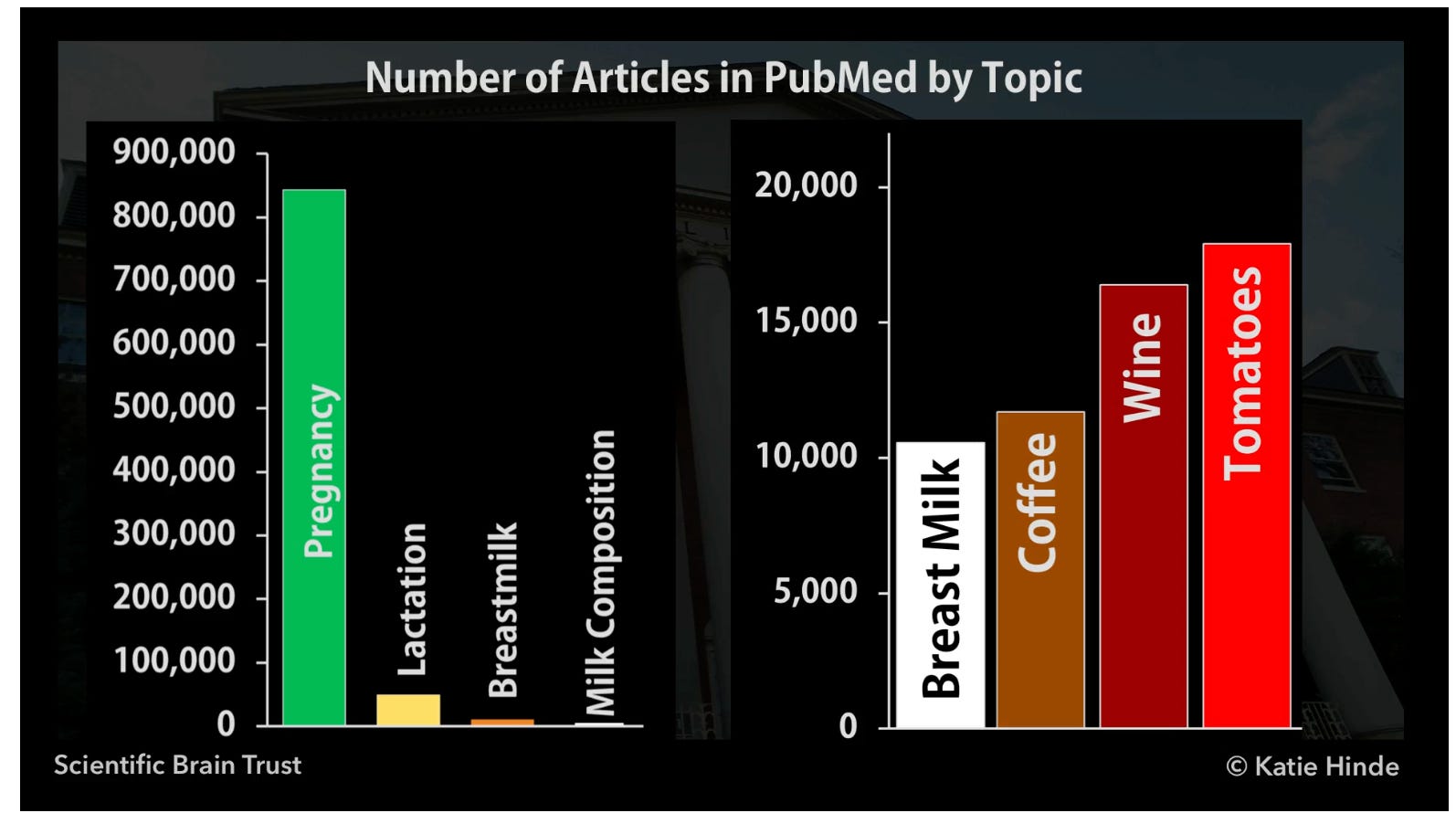
And so the problem with “following the science” is particularly clear when it comes to mothers and babies and breastmilk: there’s not much of it. As has been well-documented (see Cat Bohannon’s book, Eve) mothers and babies have basically been ignored by science since the inception of Western medicine and scientific research. So to claim that we can look at the science to find the truth is preposterous when dealing with mothers and babies.
Sadly, this has lead to a lot confusion and misinformation. That’s why, the hugely influential author and economist Emily Oster can get away with the following statement, proclaimed boldly in her best-selling book Cribsheet, “The data do not provide strong evidence for long-term health or cognitive benefits of breastfeeding your child.” After years of researching breastmilk, I was so astounded by this summarization, I immediately emailed Bruce German, professor of food science and technology at UC Davis, who has been studying breastmilk for 25 years. He wrote back almost instantly, “Emily’s perspective is the legacy of decades of indifference to breastfeeding from the scientific community, clever study designs and aggressive marketing by the infant formula industry and the staggering lack of social support at every level for the basic concept of breastfeeding and nourishing infants.”
And still, thanks to researchers like Bruce German, Katie Hinde and others, there is a lot we can now name in breastmilk and by outlining some of it here we can see just how vast the differences are between breastmilk and artificial milk.
Below is the ingredient list for one of the top-selling infant formulas in the U.S. and the top pick in The New York Times Wirecutter series (I also want to note what the introduction to their formula picks says, “we learned that all FDA-approved formulas made for healthy, full-term infants are safe and nutritionally adequate for normal growth and development from birth through the first year.” This is simply not true; formula feeding comes with risks that are absent with breastfeeding).
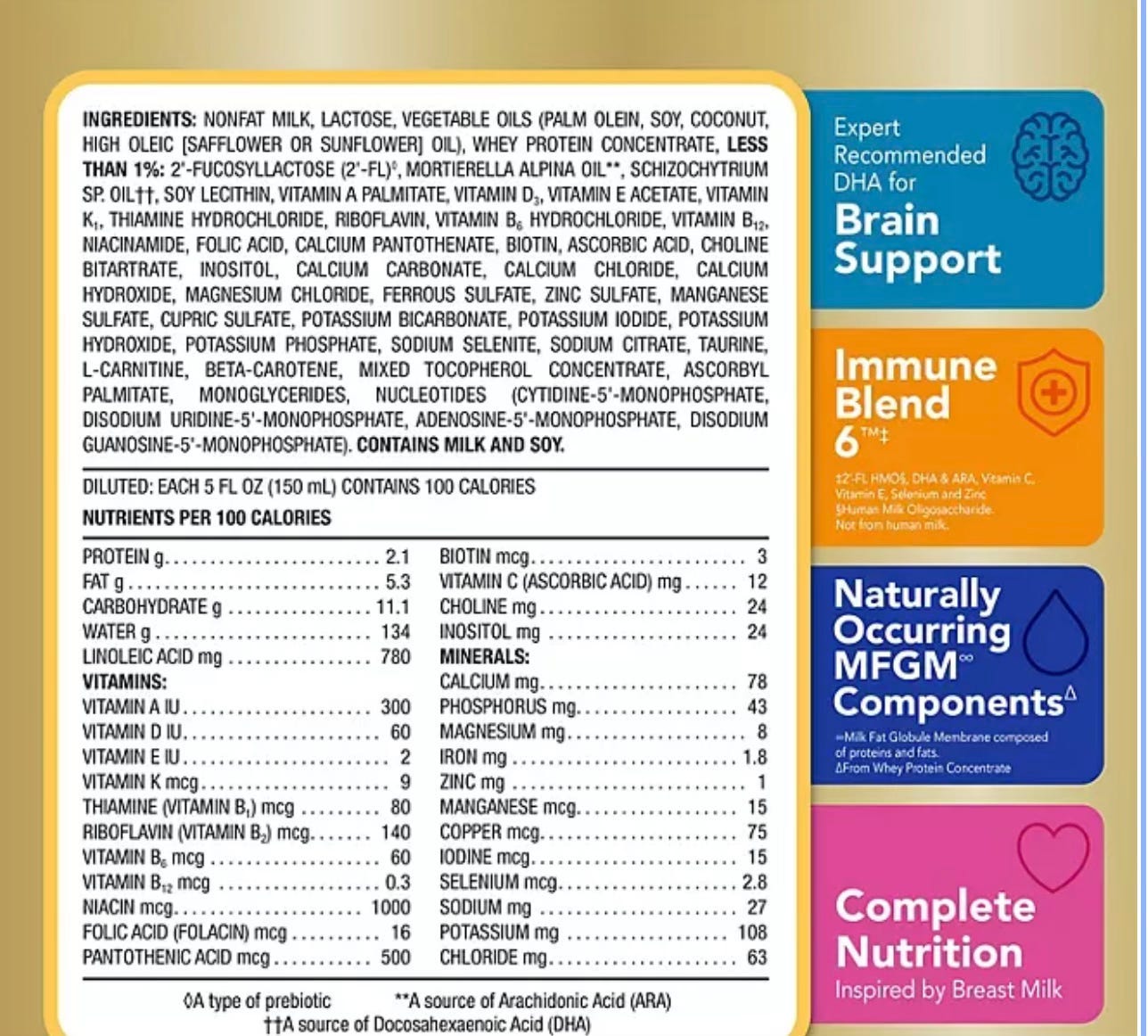
The main ingredients in this artificial milk are nonfat cow’s milk, lactose, vegetable oils, whey protein concentrate, an assorted, albeit static, combination of vitamins, minerals, fatty acids, human milk oligosaccharides, prebiotics, and four types of nucleotides (these are building blocks of DNA and RNA, which come from cows milk in most formulas).

Now compare that to the following snapshot of some of the known wildly complex—and custom made for each baby—components and actions of breastmilk (the following information will be greatly expanded into at least one chapter in my book).
Hormones, including: oxytocin, prolactin, estrogen, progesterone, cortisol, glucocorticoids, thyroid hormones, insulin, metabolic hormones, leptin, ghrelin; these play a vital role in infant development, behavior, bonding, sleep, appetite, body weight, metabolic health, sexual development, and much more.
Immunofactors and antibodies including: secretory IgA which protects the baby’s digestive and respiratory tracts from infections; immunoglobulin IgG which provides broad protection against many pathogens.
Immune cells including leukocytes, which are white blood cells with high antimicrobial activity; lymphocytes which help develop the immune system and provide immune memory.
Essential amino acids, there are 20 amino acids needed for the proper construction of the body; infants and children need significantly more of every essential amino acid than adults. Of all the food sources of amino acids the very best is breast milk.
Fatty acids; the developing brain is made from fatty acids like DHA, EPA, and ARA, neither the fetus nor the baby has the capacity to make these lipids so they must come from breastmilk and they must be delivered at precisely the right time in development. These fatty acids are not found in cow’s milk and they are critical for brain development, eyesight, and intelligence.
Lactoferrin, a protein that binds to iron and prevents bacterial overgrowth and is particularly high in colostrum, the first substance produced after birth and for the first few days of life before the mature milk comes in.
Growth factors, including Epidermal Growth Factor, which promotes cell growth, proliferation, and repair in the skin and gastrointestinal tract; Vascular Endothelial Growth Factor, which is involved in the formation of new blood vessels; Hepatocyte Growth Factor, which stimulates the growth of intestinal cells and is especially critical in preventing necrotizing enterocolitis; and an array of others which are crucial for proper immune system development and gastrointestinal health.
Human milk oligosaccharides (HMOs), these are the third most abundant component in breastmilk after lactose and lipids; HMOs are complex carbohydrates that feed beneficial bacteria and are critical for developing a healthy immune system. So far about 15 different HMOs have been discovered in breastmilk, the amount and type vary between women and at different stages of lactation. Among many actions, they provide protection against viral pathogens, promote the maturation of the immune system, and create a more balanced cytokine response.
Cytokines, signaling molecules that regulate immune response and help protect against inflammation.
Lysozyme, an enzyme that breaks down harmful bacterial cell walls and is highly antimicrobial.
Micro RNA, which shape immune mechanisms and promote immunity; one key aspect of micro RNA is in oral tolerance development, which teaches the immune system how to respond to dietary antigens without provoking allergic reactions.
Stem cells, they are particularly high in colostrum and before the baby is five days old he will receive 5 million stem cells from his mother. Maternal stem cells present in breastmilk bypass the gastrointestinal tract, and contribute to optimal infant immune development and tissue growth and repair.
Alpha-lactalbumin, a protein that, in an infant stomach refolds itself and picks up a fatty acid from breastmilk, forming a new complex which the Swedish scientist, Catharina Svanborg, who discovered it, calls HAMLET. She found that it kills 40 types of cancer cells in a dish, including bladder, lymphoma, skin, and brain.
Nucleotides, these are the building blocks of DNA and RNA, and they are much higher in human milk than other species’ milks; they strongly influence the development and function of the infant’s immune system, gut, brain, and nervous system.
Endocannabinoids, enticing infants to eat and also regulating appetite so infants feel full by the end of a feeding.
The breast “knows” if the infant is a boy or a girl, tailoring the milk respectively. Mothers of sons produce fattier, more energy dense milk, possibly because males have higher growth rates; but mothers of daughters make more milk, for reasons still not fully understood.
Breasts sense an infection in babies and respond by producing milk with more lactoferrin, which prevents bacterial overgrowth, as well as antibodies tailored specifically for the pathogens present in the baby’s saliva.
Much of what I have outlined here is just in the beginning stages of scientific discovery and much has yet to be uncovered. When you look at what comprises breastmilk and the complex interactions between each individual infant and her mother’s milk it’s strikingly apparent that the infant formula industry refrain “fed is best” is inaccurate and harmful to both mothers and babies. It parallels the food industry mantra that “a calorie is a calorie” which we know is also blatantly false ( I wrote about this here, long ago: A Calorie, is a Calorie, is a Calorie. Or is it?)
Breastfeeding should be at the very top of our priority list when it comes to public health preventative measures, not “cleaning up” infant formula. Since many of the health benefits of mothers’ milk are still unknown we first need to begin by taking it seriously in scientific research, says Bruce German. He hopes to see the National Institutes of Health embark on a Framingham-like study to explicitly examine breastfeeding and health outcomes. “We should be arguing for science to take mothers and infants seriously and just measure them. If the data are balanced, accurate and unbiased, we will finally begin to know how to help,” he says.
One main reason this conversation is so volatile and painful is because no one wants to think that they made a decision that could have potentially harmed their child. But no one makes these decisions on an individual basis, the culture deeply informs them. As Kimberly Allers wrote in The Big Letdown, “Individuals don’t breastfeed, cultures breastfeed.” And we don’t live in a culture that understands the value or importance of breastfeeding, which is in large part because our current cultural norms are heavily swayed by commercial interests and male-dominated science.
What would our health outcomes look like if we prioritized mothers and infants by seriously studying them in our sciences and then supporting every mother’s ability to breastfeed with a universal cash stipend to ensure they can be with their babies to breastfeed? We don’t know yet because it has never been attempted, but I believe the public health benefits would go far beyond any other possible measure.
And while we anticipate more science on breast milk and breastfeeding, let’s make the leap that 200 million years of mammalian evolution—with lactation as its cornerstone—got something right.
For those of us who advocate for human milk for human babies - we are in general, speaking in big picture terms - public health level. For those of in the field, we are intimately aware of the struggles which individuals face with specific breastfeeding challenges. Many of us work closely with these mothers and families. Nobody is saying that anyone is superior to anyone. What we object to, is the pervasive message (mostly perpetuated by infant formula manufacturers - who make MILLIONS with that message) that formula is equal to breast milk - it simply isn't true. I think I speak for those in the field that we care deeply about ALL mothers and infants regardless of feeding method.
As always with articles like this, we’d do well to learn the difference between being shamed and feeling shamed. Facts can’t shame anyone. The feelings of inadequacy, guilt, and more can lead one to shame. Those are separate from the facts.